
It may have been history’s most consequential weather forecast.
The Allies were ready for their long-planned D-Day landings on the beaches of Normandy—the largest amphibious assault in history, which would kick off Operation Overlord. The planned date for the top-secret invasion? June 5, 1944. There was little wiggle room with the timing for many reasons, including moon phases and tidal patterns. The planners were convinced it had to be June 5. Only one thing could delay D-Day: the weather.
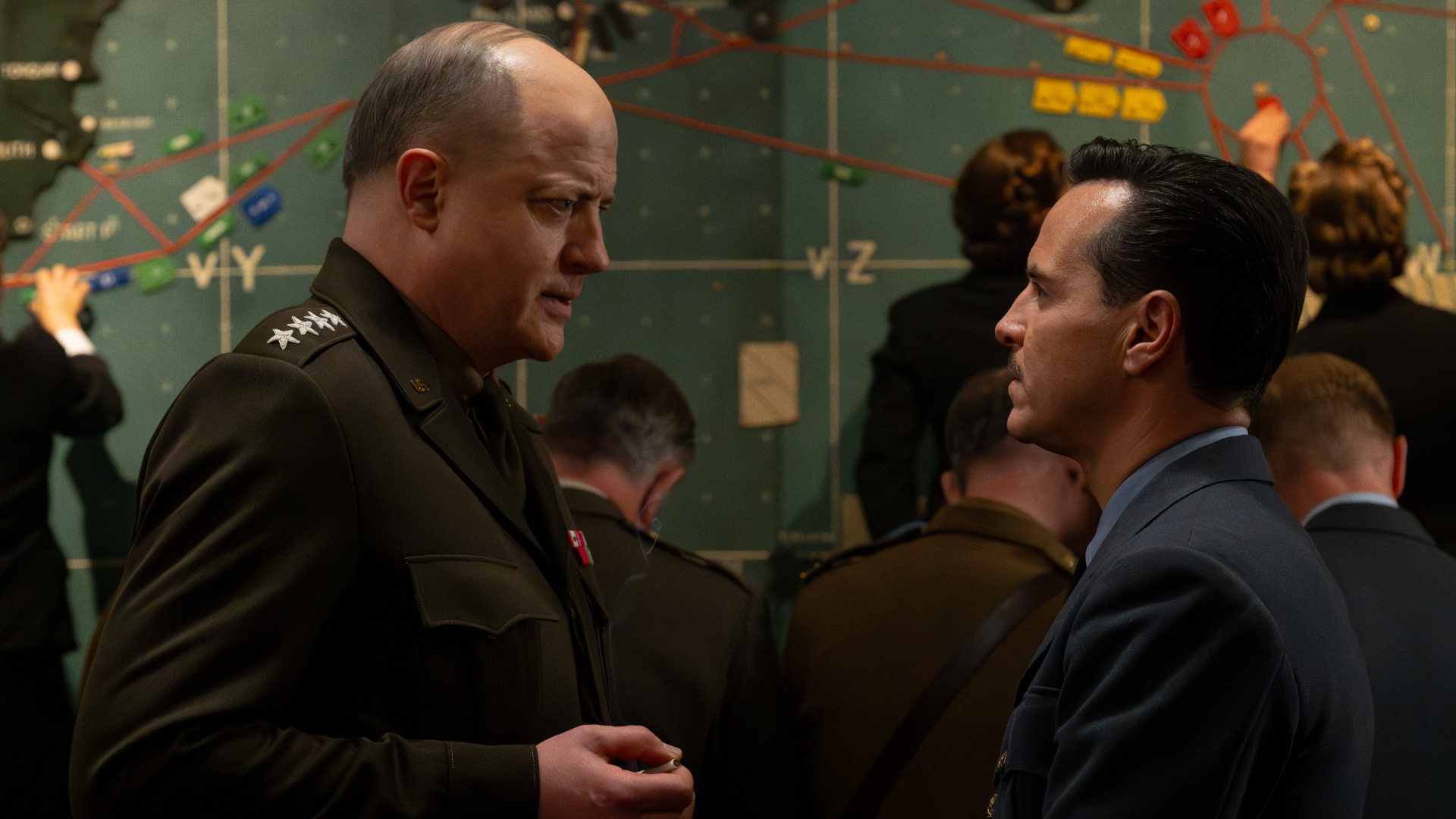
This made one senior adviser, chief meteorological officer James Stagg (Andrew Scott), hugely important. His ominous forecast for the weather on June 5 wasn’t what Commander Dwight D. Eisenhower (Brendan Fraser) and other Allied leaders wanted to hear. But it’s what they needed to hear. And by Stagg sticking to his best-guess forecast—even when it threw a major wrench into the fine-tuned timing of D-Day—he likely saved thousands of lives and averted military disaster.
When Eisenhower was later asked by John F. Kennedy why the D-Day invasion had been so successful, he answered, “Because we had better meteorologists than the Germans!”
Pressure (rated PG-13) tells this story—the meteorologist who helped the Allies win the war. It’s riveting, incredibly well acted, and full of inspiring lessons in leadership.
High-Stakes Decision
Directed by Anthony Maras (Hotel Mumbai) and based on David Haig’s 2014 stage play, Pressure is less an action spectacle and more an actor’s showcase for Scott, Fraser, and Kerry Condon (who plays Eisenhower’s personal secretary). There are some brief action scenes of the D-Day beach invasion—including newly colorized archival footage—but most of the dialogue-driven film takes place within the war rooms and offices of Southwick House, the main command post for the Allies preparing for D-Day.
The approach works well because the deliberations and decision-making that take center stage couldn’t possibly have reached higher stakes. The film’s apropos title refers to the atmospheric pressure so critical in shifting weather, but also the pressures these leaders faced in their decisions. What emerges is a compelling portrait of strong, effective leadership in the crucible moments that define history’s heroes.
Eisenhower: Owning Decisions
Eisenhower’s wartime leadership is legendary and propelled him to later become the U.S. president. Few moments demonstrated his leadership prowess quite like D-Day and the decision on timing. Should they move forward on the planned day (despite potentially cataclysmic stormy weather) or delay in hopes of better weather (but with less surprise and potentially a litany of other problems)?
Leaders must be decisive even when all options have downsides. They can’t endlessly waffle, nor can they defer to subordinates to make the call. True leaders make impossible decisions and own the consequences. Eisenhower was that kind of leader.
True leaders make impossible decisions and own the consequences.
Eisenhower “wants certainty,” but as Stagg reminds him, certainty about the weather is “scientifically impossible.” Certainty is almost never a luxury leaders have in decision-making.
In this case, the uncertainty is aggravated by Eisenhower’s top two weather advisers—Stagg and his American counterpart, Irving Krick (Chris Messina)—saying contradictory things. Stagg is convinced a series of storms in the North Atlantic will bring bad weather to the English Channel around June 5, but Krick—looking mostly at historic patterns on analog weather charts—insists it’ll be a sunny day.
So Eisenhower must choose between two contradictory forecasts from two trusted advisers, even as he gets pressure from his subordinates, like ground forces commander Bernard Montgomery (Damian Lewis), to proceed with June 5 no matter what (“The weather is irrelevant”). Ultimately, Eisenhower makes the risky choice to delay by a day, listening to Stagg when he suggests that a small “gap” of good weather between storms might provide a window of decent (far from perfect) weather for the invasion.
In a telling moment, Eisenhower prepares two possible statements for the press: one in the event of D-Day success and one in the event of failure. The latter handwritten note includes this line: “If any blame or fault attaches to the attempt it is mine alone.”
He underlined “mine alone.” That’s leadership. Not deflection or blaming others but taking responsibility, owning the consequences of the shots you call.
Stagg: Truth-Telling over Being Liked
Even though Stagg is less well-known than Eisenhower, his leadership in the critical lead-up to D-Day is arguably just as consequential for history.
The movie begins with Stagg saying goodbye to his pregnant wife (Tamsin Topolski) and “going to work” to his secretive post with Operation Overlord. It ends with him returning to her, having played his part and done his job. This framing is brilliant. It positions Stagg’s role not as self-consciously history-altering but simply part of his everyday duty and vocation. He went to work, did the thing he was asked to do, to the best of his ability and under great pressure, and then went home to his wife. Everyday valor.
What also stands out about Stagg’s leadership is how committed he is to truth and reality over politics and being liked. He doesn’t want convenient opinions. He wants the truth. “Get me the data,” he instructs his staff. “That’s what counts.”
When presenting his forecast to Eisenhower and the military brass, he says, “I don’t expect you to like me, but I do ask you to listen to me.” His mic-drop line preaches not only in 1944 but also in 2026: “We must face the facts, however frightening they may be!”
Lesser leaders can be tempted to cite “alternative facts” that fit the narrative their boss or political party wants to believe. But great leaders seek reality, even when it doesn’t serve them or demands they alter course.
Great leaders seek reality, even when it doesn’t serve them or demands they alter course.
Pressure rarely feels like an overt commentary on contemporary politics. Still, its challenge resonates in a world where truth is fragile and narrative spin pervasive. Choose truth over power, facts over spin, reality over convenient narratives. As you do, you’ll become a leader people trust.
God’s Sovereignty and Human Science
One of the most fascinating scenes in Pressure happens on the morning of Sunday, June 4, as Eisenhower and his staff gather in a church for worship. With organ accompaniment, they belt out “All Creatures of Our God and King,” a hymn about how all things in nature—even “rushing winds that art so strong”—praise God.
As the worshipers sing, the sunny skies outside start to give way to clouds, the winds pick up, and the storms Stagg predicted start to move in. Stagg opts to remain outside under a tree rather than attend church. As the rain starts to fall, he’s vindicated. His forecast was right—and Eisenhower was right to listen to him.
Some might read in this scene a “science vs. religion” dichotomy, with the film’s scientific hero, Stagg, remaining outside—perhaps feeling unwelcome in—the church. But I interpret this scene as an admission that weather is an “act of God,” a realm stubbornly uncontrollable by humans but rather driven by God’s ingenious design and sovereign will.
Sure, smart meteorologists and new technologies (now including AI) can predict weather to an impressive degree. But in the end, weather tends to defy patterns and predictions. Eisenhower admits this when he says at one point, “Pray for good weather.” Weather controls our lives, but we can’t control it. So we must appeal to the One who does.
Weather controls our lives but we can’t control it. So we must appeal to the One who does.
Was God working through the weather to orchestrate the outcomes of this history-altering invasion? Was God working through the weather forecasters like Stagg, whose brilliant reading of the weather patterns proved so consequential? Probably both.
God created weather in all its beautiful grace and uncontrollable fury—something that can feed us and kill us. But he also created humans with the creative capacity to understand and predict this wild weather, even if they can’t control it. Both are on beautiful display in Pressure, and both should inspire us to praise him.